
OECD projects
OECD projects are classified as Category A, B or C depending on their sustainability risk. For Category A projects, a summary of the Environmental and Social Impact Assessment (ESIA) is published at least 30 days before Eksfin makes its final decision.
Our projects
OECD Projects Pending Review
OECD projects are published here at least 30 days before Eksfin makes a financing decision. The relevant environmental and social impact assessment can be accessed via the ESIA link.
| Project | Eksfin Involvement | Sector | Country | OECD Risk | Year | ESIA | Deadline for comments |
|---|---|---|---|---|---|---|---|
| Energy Valley | Guarantee | Solenergi og batterilagring | Egypt | A | 2026 | Link | 4.11.26 |
| Greater Changhua 2 | Wind power | Taiwan | A | 2025 | Link | Closed | |
| Hai Long | Guarantee | Wind power | Taiwan | A | 2022 | Link | Closed |
| Sakarya | Gas Field | Turkey | A | 2022 | Link | Closed | |
| Vissim | Guarantee + loan | ICT | Benin | B | 2022 | Closed | |
| Doggerbank A+B | Guarantee + loan | Wind power | Great Britain | A | 2021 | Link | Closed |
| Doggerbank C | Wind power | Great Britain | A | 2021 | Link | Closed | |
| Seagreen | Guarantee | Wind power | Great Britain | B | 2020 | Closed | |
| Changfang Xiadao | Guarantee | Wind power | Taiwan | A | 2020 | Link | Closed |
| Ningbo | Guarantee + loan | Aquaculture | China | B | 2020 | Closed | |
For comments, please contact sustainability@eksfin.no.
Recent transactions
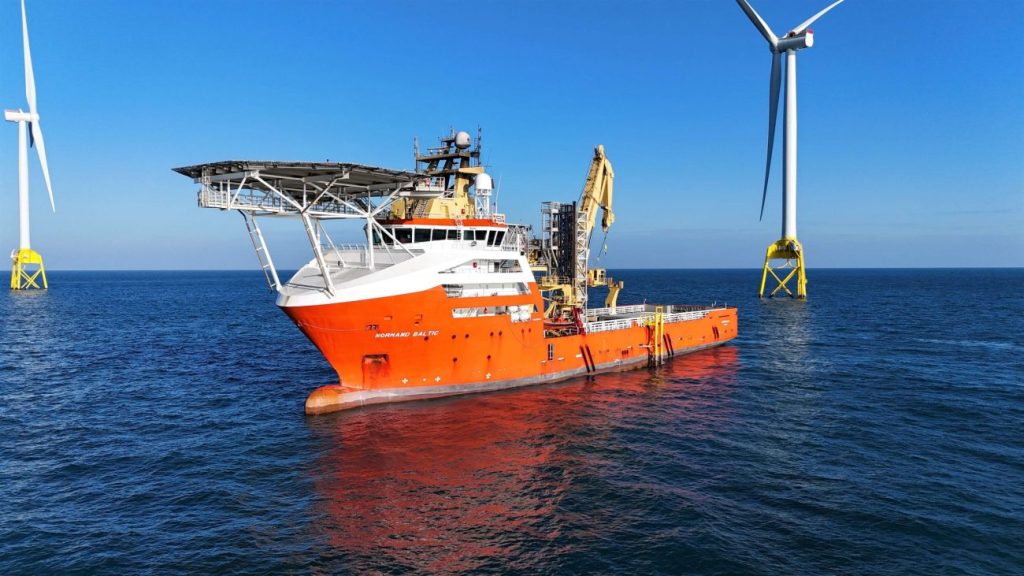
Eksfin finances NOK billion‑scale exports to the Greater Changhua 2 Offshore Wind Farm in Taiwan
The risk classification is based on the OECD Common Approaches and the Equator Principles. Through a risk-based approach, we adapt our requirements to the level of risk and the potential adverse impacts of each project. We place particular emphasis on risks within the supply chain.
High Risk
Category A
Projects that may have significant adverse environmental and social impacts, some of which may be irreversible. Certain impacts may be difficult to mitigate and may affect a wider area beyond the project site or facilities themselves. An illustrative list of such projects is provided in Annex I of the OECD Common Approaches.
Medium Risk
Category B
Projects with potential adverse environmental and social impacts that are less significant than those of Category A projects. Typically, these impacts are fewer in number, site-specific, largely reversible, and more readily addressed through mitigation measures.
Low Risk
Category C
Projects with a low risk of adverse environmental and social impacts. Eksfin requires a systematic approach to risk identification and risk management. These are typically projects located in Norway or deliveries to existing facilities.
Please Note
Please note that exports to existing facilities may still be associated with a higher level of risk if:
– The facility is located in or near protected areas.
– The facility has a significant environmental footprint, or operates in a country with significant challenges related to labour rights and working conditions.
– An Environmental and Social Management Plan (ESMP) is required.
– Eksfin and/or approved representatives conduct a site visit to the project.
– A project description, including a link to the Environmental and Social Impact Assessment (ESIA) and/or a non-technical summary, is published on Eksfin’s website at least 30 days prior to Eksfin’s final decision.
Documentation Requirements for Category A and B Projects
For projects with high or medium potential risk, Eksfin may require the following documentation:
| Category A exceeding NOK 100 Million | Category A below NOK 100 Million and Category B | |
|---|---|---|
| Documentation Requirements | ||
| Documentation of a systematic approach to identifying and managing risks | Yes | Yes |
| Environmental and Social Impact Assessment (ESIA) in accordance with the IFC Performance Standards | Yes | Yes, for high-risk projects |
| Climate Risk Assessment in accordance with the Equator Principles | Yes | No |
| Action Plan in accordance with the IFC Performance Standards | Yes | Yes, for high-risk projects |
| Eksfin’s Monitoring | ||
| Eksfin conducts site visits | Yes | Yes, for high-risk projects |
Contact us
Do you have any questions?
Please contact us if you have any questions about risk classification or the requirements that apply to the different risk categories.
Senior Sustainability Adviser
Senior Sustainability Adviser
Senior Sustainability Adviser